
Reviewed · HISTORICAL TOURS
Taipei Historic Shared Walking Tour
Taipei’s past is written into its streets. This three-hour walk links six major sights across old Taipei, moving from Qing-era immigrant communities to Japanese colonial rule and the post-1949 Nationalist government. I especially like the route’s clear historical arc and its mix of major monuments with places such as Bopiliao Historic Block, where everyday trade shaped the city.
At just $5, the tour offers remarkable value if you want an introduction before exploring Taipei on your own. I also like that guides such as Amy, Fu, Andy, Mabel, Susie, Huawen, Eric, Luke, and Pauline have been praised for lively explanations and strong English. The main caution is pace: three hours on foot, with up to 20 people, can feel demanding for young children or anyone who needs frequent breaks. Gratuity is not included, so plan to tip your guide.
In This Review
- Key points to know before you go
- Why this route explains Taipei so well
- Longshan Temple: begin with living religion
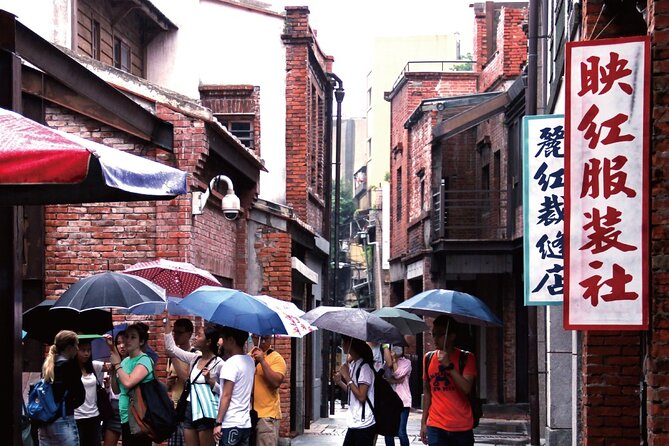
- Bopiliao Historic Block: old trade in a preserved street
- Ximen Red House and Ximending: from market to theater district
- Presidential Office Building: power in a former colonial headquarters
- 228 Peace Memorial Park: a necessary pause
- Chiang Kai-shek Memorial Hall: the grand final chapter
- What the $5 price really gets you
- Timing, walking comfort, and group size
- Who will get the most from this walk
- Should you book the Taipei Historic Shared Walking Tour?
- FAQ
- How long is the Taipei Historic Shared Walking Tour?
- What time does the tour start?
- Where does the tour begin?
- Where does the tour finish?
- What attractions are included?
- Is admission to the sights included?
- Is the guide’s tip included?
- How many people can join the tour?
- Can I cancel for a full refund?
Key points to know before you go
- A 300-year story in three hours: The route connects late Qing immigration, Japanese colonial planning, political change, and the Nationalist era.
- Six major West Taipei sights: You visit Longshan Temple, Bopiliao Historic Block, Ximen Red House, the Presidential Office Building, 228 Peace Memorial Park, and Chiang Kai-shek Memorial Hall.
- A strong first-day choice: The walk gives you context for Taipei’s religion, architecture, food culture, and politics before you explore farther afield.
- Guides make the difference: Amy, Fu, Andy, Mabel, Susie, Huawen, Eric, Luke, and Pauline have been singled out for clear English, enthusiasm, and thoughtful answers.
- Excellent price, shared format: The $5 fee covers the professional English guide and system fee, but not the guide’s tip.
- Plan for a full morning on foot: The tour starts at 10:00 a.m. and ends at Liberty Square beside Chiang Kai-shek Memorial Hall.
Why this route explains Taipei so well
West Taipei was once the city’s political and commercial center. That makes this route more useful than a simple checklist of monuments. Each stop adds a different layer to the city, and the order helps you see how Taipei changed over time.
You begin with local religion and Chinese immigrant settlement. Then you move through an old commercial street, a Japanese-era market building, the former center of colonial government, a park tied to one of Taiwan’s darkest political episodes, and finally the grand memorial to Chiang Kai-shek.
I like this structure because it does not treat Taipei as one fixed culture. You see Chinese traditions, Japanese urban planning, local Taiwanese memory, and the political ideals brought by the Republic of China government after 1949. The route gives you useful background without requiring a separate museum visit first.
The guides also add value. Amy and Fu have been praised for engaging presentations and excellent English. Andy and Amy have been appreciated for answering questions about history and culture, while Eric and Mabel have explained architecture, religion, food, and local life. Pauline has even managed explanations in three languages. Guide assignments can change, but the repeated praise points to a team that knows how to keep a walking group involved.
More history-first tours:
- Taipei Cooking Class & Market Adventure in Historic Dadaocheng
★ 5.0 · 77 reviews - WoknRoll Taipei Walking and Historical Food Tour
★ 5.0 · 10 reviews - One-Day Historical and Heritage Tour in Taipei
★ 4.5 · 6 reviews
Longshan Temple: begin with living religion
The tour starts at Longshan Temple, with about 40 minutes here. Admission is free, and the temple serves as a religious center for the local community rather than simply a photo stop.
The temple was first established in the 18th century by Chinese immigrants who came to Taipei. Those settlers later helped build Monga District, one of the foundations of the old city. This makes Longshan a useful opening chapter: before Taipei became a modern capital, it was shaped by immigrant communities, trade, faith, and neighborhood networks.
I would pay close attention to the guide’s explanation of how the temple fits local life. The value is not only in the decoration or the age of the site. It is in understanding why this place still matters to people living nearby.
Forty minutes is enough for an introduction, though not for a detailed study of every religious feature. The temple can also be an active place, so you should listen carefully and follow your guide’s instructions about where to stand and how to behave. This is a religious site first and a sightseeing stop second.
Bopiliao Historic Block: old trade in a preserved street
Next comes Bopiliao Historic Block, with roughly 30 minutes to explore. The name refers to skin peeling, an unusual term that immediately hints at the area’s older commercial character.
Bopiliao was once a major commercial center in northern Taipei. Chinese immigrants traded here with Indigenous communities, and the street became part of the economic life of old Monga. That detail gives the stop a wider purpose. You are not just looking at old buildings. You are seeing a place where different communities met through business and exchange.
This is one of the most useful stops for understanding how a city grows. Political power may attract attention, but trade often creates the daily connections that hold a city together. The guide’s stories and local legends help bring that process into focus.
Thirty minutes is a sensible amount of time. You get enough to understand the street’s role without spending the morning on architectural details. If you like old neighborhoods and prefer human stories to grand monuments, Bopiliao may be one of your favorite parts of the route.
Ximen Red House and Ximending: from market to theater district
The walk continues to Ximen Red House and Ximending for around 30 minutes. The Red House was originally built as a public market and has strong Japanese colonial architectural features.
That original purpose matters. Markets reveal how authorities planned public life, trade, and movement. After World War II, when Japanese rule ended, the building became a theater. Its later use shows how the same structure adapted to a new political and cultural period.
The stop also introduces Ximending, one of Taipei’s best-known entertainment areas. The contrast is sharp: you move from older streets and temple culture into a part of the city associated with modern urban life. The walk helps explain that change instead of presenting Ximending as only a shopping and nightlife district.
I appreciate that the tour does not isolate the Red House from its surroundings. The building makes more sense when you see its place beside the lively streets of Ximending. At the same time, 30 minutes will give you an overview rather than a long independent visit. If you want to browse shops, eat, or spend time inside the Red House, save that for another visit.
More walking tours:
- Taipei Old Town – Taiwan Introduction Walking Tour (Tip-Based)
★ 5.0 · 175 reviews - [Private Tour] Shilin Night Market Walking Tour With a Private Tour Guide (2-hr)
★ 5.0 · 123 reviews - 2-hr Raohe Night Market Walking Private Tour with a Tour Guide
★ 5.0 · 61 reviews - Vintage Taipei – Best of Taiwan & Sunset Walking Tour (Tip-based)
★ 5.0 · 52 reviews
Presidential Office Building: power in a former colonial headquarters
Only a short walk from Ximending, the Presidential Office Building offers a major change in tone. The building was completed in 1919 and originally housed the Office of the Governor-General of Taiwan during Japanese colonial rule.
The stop lasts about 20 minutes, making it the briefest scheduled visit. That is enough to place the building in the route’s political story, but you should not expect an extended architectural tour. The guide’s explanation is the main reason to stop here.
This building shows how colonial government made its authority visible in the city. Its position near modern commercial Taipei also makes the transition easy to grasp. In a few minutes, you go from a former market and theater district to the institutional center of political power.
I find the contrast important. Taipei’s history is not only about temples and old streets. It is also about who controlled the city, how that control was expressed, and how earlier government buildings continued to shape the capital after political power changed hands.
228 Peace Memorial Park: a necessary pause
The next stop is 228 Peace Memorial Park, with approximately 30 minutes here. The park was first created in 1908 as Taihoku New Park during Japanese colonial rule. It was designed as Taiwan’s first European-style park.
That origin gives the park an architectural and urban-planning role, but its later history is even more important. In 1947, it became a site of protest against the Kuomintang-led Republic of China government. The 228 Incident remains central to Taiwan’s modern political memory.
This is where the tour shifts from buildings and urban development to public remembrance. You should expect the guide to place the park within the political tensions of the postwar period. The subject can be difficult, but skipping it would leave a major gap in your understanding of Taiwan.
The 30-minute stop should give you basic context without turning the entire walk into a memorial visit. I value that balance. You get enough background to recognize why the park matters, then continue with a better sense of the forces that shaped modern Taiwan.
Chiang Kai-shek Memorial Hall: the grand final chapter
The tour ends at Chiang Kai-shek Memorial Hall, with about 30 minutes scheduled. The route finishes at Liberty Square, where the scale becomes much larger than at the earlier stops.
The memorial honors Chiang Kai-shek, who served as President of the Republic of China from 1948 to 1975. It is a national monument and major Taipei landmark. The complex reflects the political ideals and symbolism associated with the government that arrived in Taiwan after 1949.
Ending here makes the route’s historical progression easy to see. You begin with immigrant communities and local religious life, pass through colonial government and postwar conflict, and finish with the monumental expression of Chiang Kai-shek’s Chinese national vision.
The memorial is impressive, but it also invites questions about memory and politics. The tour is most useful when it helps you see both the scale of the site and the historical debates around the person it commemorates. You may want to return later if you wish to spend more time walking through Liberty Square or examining the complex at your own pace.
The endpoint is convenient: Liberty Square, at 21 Zhongshan South Road, beside Chiang Kai-shek Memorial Hall. The tour does not return to the starting point, so keep that in mind when planning the rest of your day.
What the $5 price really gets you
The $5 fee is unusually low for a three-hour guided walk through six important sites. It includes the professional English guide and system fee, while admission to the listed stops is free.
I see the price as an invitation to start your Taipei visit with context. You are paying less for formal entry tickets and more for someone to connect places that might otherwise seem unrelated. A temple, preserved street, colonial office, memorial park, and political monument become parts of one story.
The tip is separate. Since the guide does the main interpretive work, you should budget for gratuity if the tour helps you understand the city. That keeps the headline price low, but it also means the final cost depends partly on your choice to tip.
The shared format helps explain the price. The group may include as many as 20 people, and on a busy Saturday the group can be divided between guides. That is useful for keeping the walk manageable, though it may feel less personal than a private tour.
Timing, walking comfort, and group size
The tour starts at 10:00 a.m. at the Taipei Historic Free Walking Tour meeting point, Like It Formosa108, at Section 1, Xiyuan Road 153 in Wanhua District. Confirmation arrives when you book, and the meeting point is near public transportation.
Wear comfortable walking shoes. Susie and Huawen’s group specifically emphasized this practical point, and the advice makes sense for a three-hour route through several parts of the city. The schedule includes 40 minutes at Longshan Temple, four 30-minute stops, and a 20-minute stop at the Presidential Office Building. That is a steady morning.
The tour requires good weather. If poor weather cancels it, you are offered another date or a full refund. You can also cancel for a full refund up to 24 hours before the local start time. Changes or cancellations inside that window are not accepted.
Service animals are allowed, and most people can participate. The supplied information does not describe the route’s surface conditions or seating at each stop, so anyone with specific mobility needs should confirm details before booking.
Who will get the most from this walk
I would choose this tour for a first visit to Taipei, especially if you want a quick historical framework before exploring temples, markets, museums, and neighborhoods independently.
It also suits short stays. If you have only a limited amount of time, the route covers many of the city’s essential old-center sights in one morning. The walk is useful for couples, solo visitors, and families with older children who can handle the pace.
History-minded visitors will get the most from the political sections at 228 Peace Memorial Park and Chiang Kai-shek Memorial Hall. Architecture fans will appreciate the contrast between Longshan Temple, Bopiliao, the Red House, the Presidential Office, and the European-style park.
I would be more cautious if you dislike group tours, need a slow pace, or want long periods inside each site. The walk is designed to connect places, not provide deep study at every stop. A group of up to 20 can also mean fewer chances for one-on-one questions, though the guides have been praised for handling questions well.
Should you book the Taipei Historic Shared Walking Tour?
Book it if you want affordable context fast. The $5 price, free admissions, English guide, and carefully ordered route make this one of the most useful low-cost introductions to old Taipei.
I especially recommend it for your first morning in the city. You will finish at Chiang Kai-shek Memorial Hall with a clearer sense of how religion, immigration, colonial rule, trade, protest, and political power shaped Taipei.
Skip it if you want a private experience or prefer to explore each attraction slowly. Otherwise, bring comfortable shoes, arrive ready to walk, and remember that the guide’s tip is not included. For most visitors, the tour earns its small price through the connections it makes between places you might otherwise see as separate.
FAQ
How long is the Taipei Historic Shared Walking Tour?
The tour lasts approximately three hours.
What time does the tour start?
It starts at 10:00 a.m.
Where does the tour begin?
The meeting point is Like It Formosa108, Section 1, Xiyuan Road 153, Wanhua District, Taipei.
Where does the tour finish?
The tour ends at Liberty Square beside Chiang Kai-shek Memorial Hall, at 21 Zhongshan South Road.
What attractions are included?
The route includes Longshan Temple, Bopiliao Historic Block, Ximen Red House and Ximending, the Presidential Office Building, 228 Peace Memorial Park, and Chiang Kai-shek Memorial Hall.
Is admission to the sights included?
The listed stops have free admission. The booking includes the system fee and a professional English guide.
Is the guide’s tip included?
No. You should plan to tip the guide separately.
How many people can join the tour?
The maximum group size is 20 people.
Can I cancel for a full refund?
Yes. You can cancel at least 24 hours before the local start time for a full refund. If poor weather or insufficient bookings cancel the tour, you are offered another date or a full refund.
Recently added in Taipei
- Keelung Shore Excursion: Private 6H Natural Wonder & Seafood Tour★ 5.0 · 3 reviews
- One-way Private Transfer between Jiufen and Taipei★ 5.0 · 3 reviews
- 8-Day Around Taiwan Private Tour★ 5.0 · 3 reviews
- National Palace Museum Northern Branch Taiwan Admission★ 4.5 · 3 reviews
- 12hrs – Chiayi Meteor Garden Classic Tour From Taipei★ 5.0 · 3 reviews
- Yilan 1-Day Private Tour to Kavalan Whisky & Cultural Gems★ 4.5 · 3 reviews
- Best of Taiwan 9 Days Tour★ 3.5 · 3 reviews
- Full Day Private History Tour in Taipei City★ 4.5 · 3 reviews
Historical Tours, compared.

Taipei Cooking Class & Market Adventure in Historic Dadaocheng
Read our review →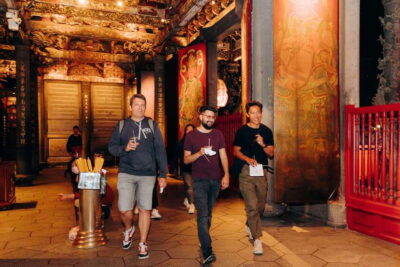
Taipei’s Origin & Longshan Temple – Taiwan Cultural Tour
Read our review →
Cooking Class & Market Adventure Historic Dadaocheng
Read our review →
WoknRoll Taipei Walking and Historical Food Tour
Read our review →
Guided Historical Tour in Taichung with Suncake DIY Experience
Read our review →

Browse the lists this tour appears in